A Japanese reply-paid postcard, ofuku hagaki (往復はがき), joins an outgoing postcard and a reply postcard into one sheet. For the first journey, fold it with the outgoing address facing outward. For the return journey, separate and post the reply half. Japan Post currently lists the domestic reply-paid postcard at ¥170, compared with ¥85 for an ordinary postcard. Japan Post: postcard types and sending instructions
The crucial distinction is who receives each journey. The first address is the person or organization you are contacting; the reply address is where you want their answer to arrive. This guide is desk research for domestic use, not a tested mailing or an international reply-postage guide.
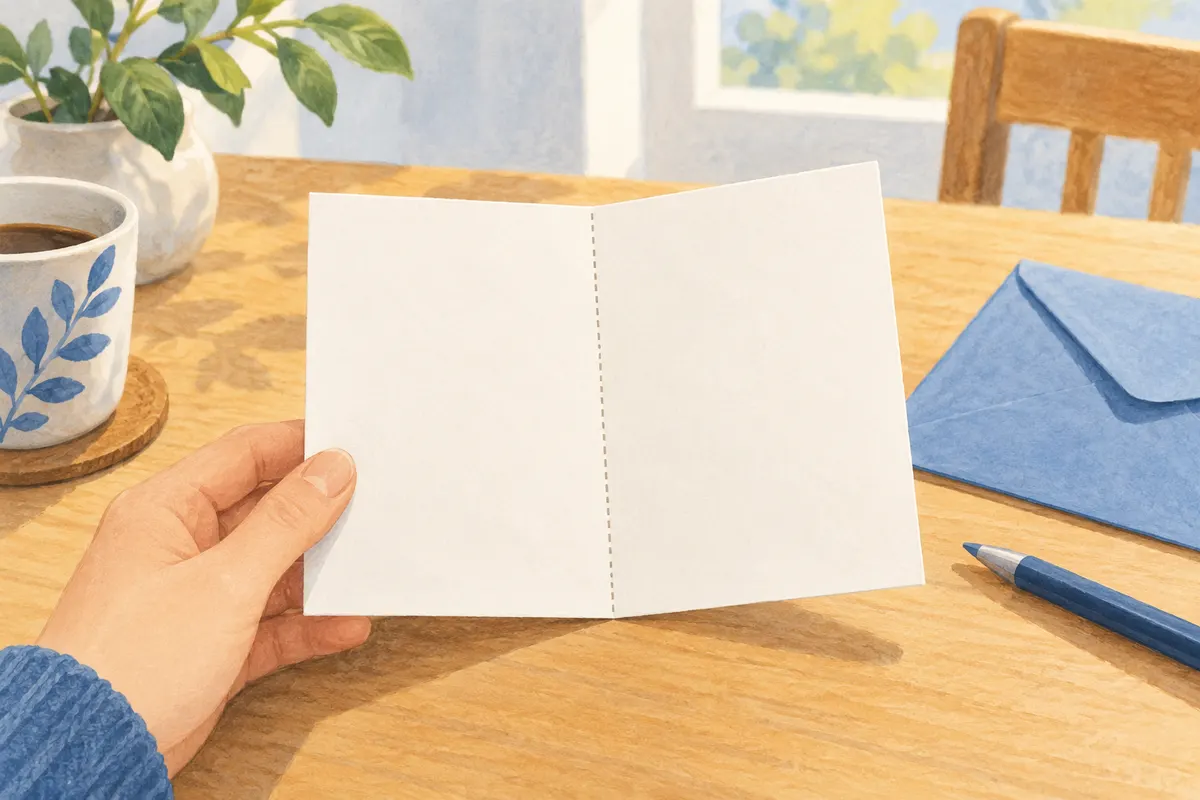
Identify the two halves before writing
Look for 往信, the outgoing half, and 返信, the reply half. Treat each half as a postcard with its own address side and message side. Do not decide which side to use solely from the color of a printed postage design.
For an event application, Tokyo Metropolitan Government gives this arrangement: the outgoing address is the application destination, the outgoing message contains the requested application details, the reply address is the applicant’s own address and name, and the reply message area is left blank for the result. Tokyo Metropolitan Government: completing a reply-paid postcard
| Part | Application example: what belongs there |
|---|---|
| 往信 address side | Organizer's destination address and name |
| 往信 message side | Event name and the details the organizer requests |
| 返信 address side | Your own destination address and name |
| 返信 message side | Leave blank for the organizer's response, unless its instructions say otherwise |
The table describes an application workflow. An organizer sending invitations may instead prepare the reply message area for guests to complete. Follow the specific form or notice rather than imposing one application template on every use.
Walk through a fictional application
Suppose Alex is applying to a community workshop and wants the result sent to Alex’s home in Japan. This is a hypothetical example, not a real event.
Alex first copies the workshop’s application address onto the outgoing address side. Alex then fills the outgoing message side with exactly the details requested in the workshop notice. On the reply address side, Alex writes the home address where the result should arrive. The remaining reply message side stays blank for the workshop’s decision.
Before folding, Alex checks one question for each destination: “Where should this go first?” and “Where should it come back?” Writing the workshop address on both halves would defeat the return journey.
The most useful final check is to imagine the organizer holding the detached reply half. It should already have a clear destination without requiring the organizer to copy your address from elsewhere.
Fold for the outgoing journey; cut for the reply
Japan Post instructs senders to fold along the center line with the outgoing address outside. Its ordinary vertical layout has the fold on the right. When replying, the recipient cuts off the reply portion along the center line and posts that portion. Both journeys can be handed in at a postal counter or put in a mailbox. Japan Post: using an ofuku hagaki
For Alex’s application, the practical sequence is therefore complete both destinations, check all four areas, then fold. Cutting before the first journey removes the attached return half that the organizer needs.
If you are the person replying, check the reply address before separating the halves, write the requested response, and send the reply half. Keep the original message if you still need its appointment or event details.
Check postage on old stock
The current ¥170 figure represents two ¥85 domestic postcard journeys: ¥85 + ¥85 = ¥170. Do not assume an older printed postcard covers current postage simply because both halves are present. If using old stock or a modified card, show the complete item at a postal counter and have each journey’s postage checked.
Japan Post also says that an unused outgoing or reply half can be used as an ordinary postcard. That does not mean a previously used half becomes reusable, or that old postage values automatically meet today’s rate. Japan Post: unused halves

Keep application rules separate from postal rules
Correct folding does not establish that an application is valid. The organizer may require a particular event name, number of applicants, deadline, or other information. Check its current notice before writing; the Tokyo example is a layout reference, not the rules for your event.
This guide does not establish international acceptance, optional-service charges, or a delivery date. It answers the physical workflow: give each half the right destination, send the joined card folded outward on the outgoing address, and detach the reply half only for its return journey.