No. A square envelope sent as a domestic letter does not qualify for Japan Post’s standard-size letter rate, even if it is thin and weighs less than 50 g. Japan Post explicitly says square items must use the non-standard letter category because the standard-size category requires a rectangular shape. Japan Post: Standard Mail Services FAQ Its current domestic rate table defines a standard letter as a 14–23.5 cm by 9–12 cm rectangle, up to 1 cm thick and 50 g. Japan Post: domestic letter rates
This is a desk-researched guide. No envelope was posted or measured for this article.
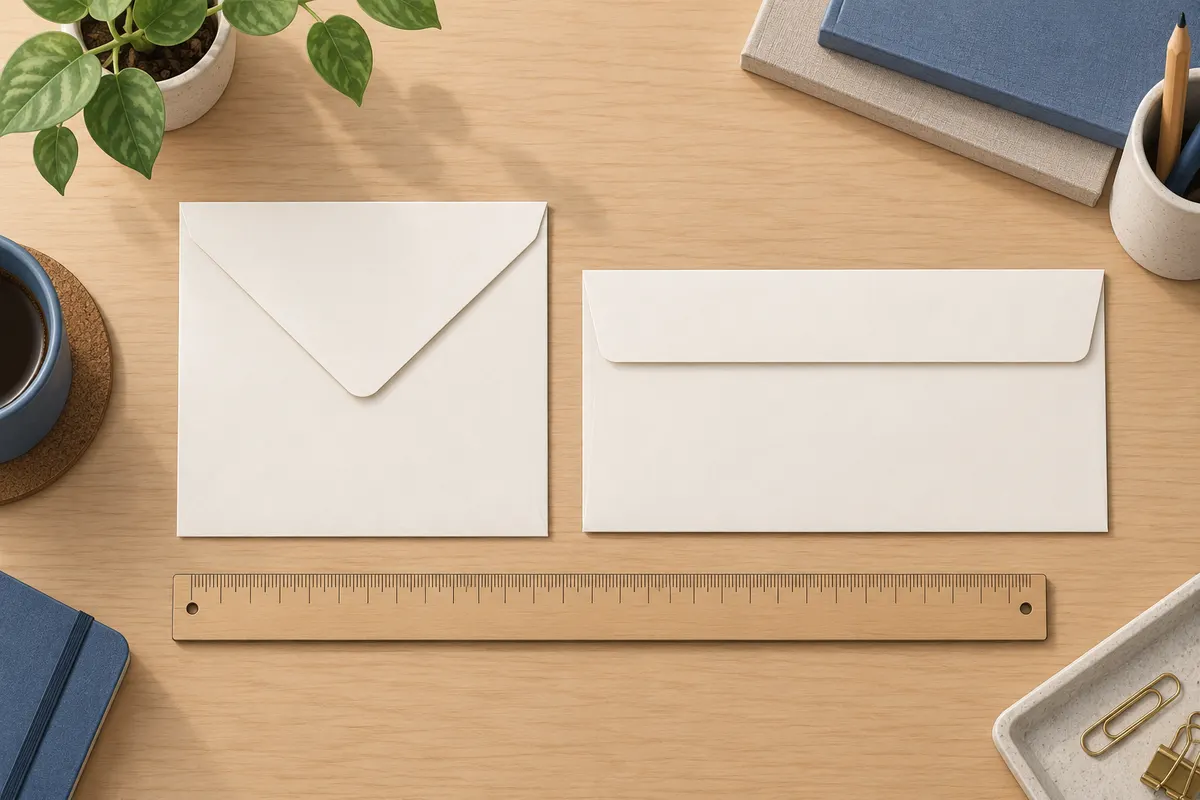
Shape is a separate test from weight
People often begin with the familiar ¥110 ordinary-letter price. That price applies when all standard-size conditions are met. A light square card in a square envelope can fail the shape test before you reach the weight test. Japan Post’s English FAQ expressly includes squares among items that must be sent as non-standard mail. Japan Post: square items
The next step is to decide which non-standard bracket applies to the finished, sealed item:
- Measure both sides and the thickest point after inserting the card and sealing the envelope.
- Weigh the envelope and everything inside it.
- Check whether it stays within the within-specified-size limits: long side no more than 34 cm, short side no more than 25 cm, thickness no more than 3 cm, and weight no more than 1 kg.
- If one of those limits is exceeded, check the over-specified-size category or ask a postal counter to classify it. Do not attach a stamp based on the empty envelope’s label. Japan Post: non-standard limits and rates
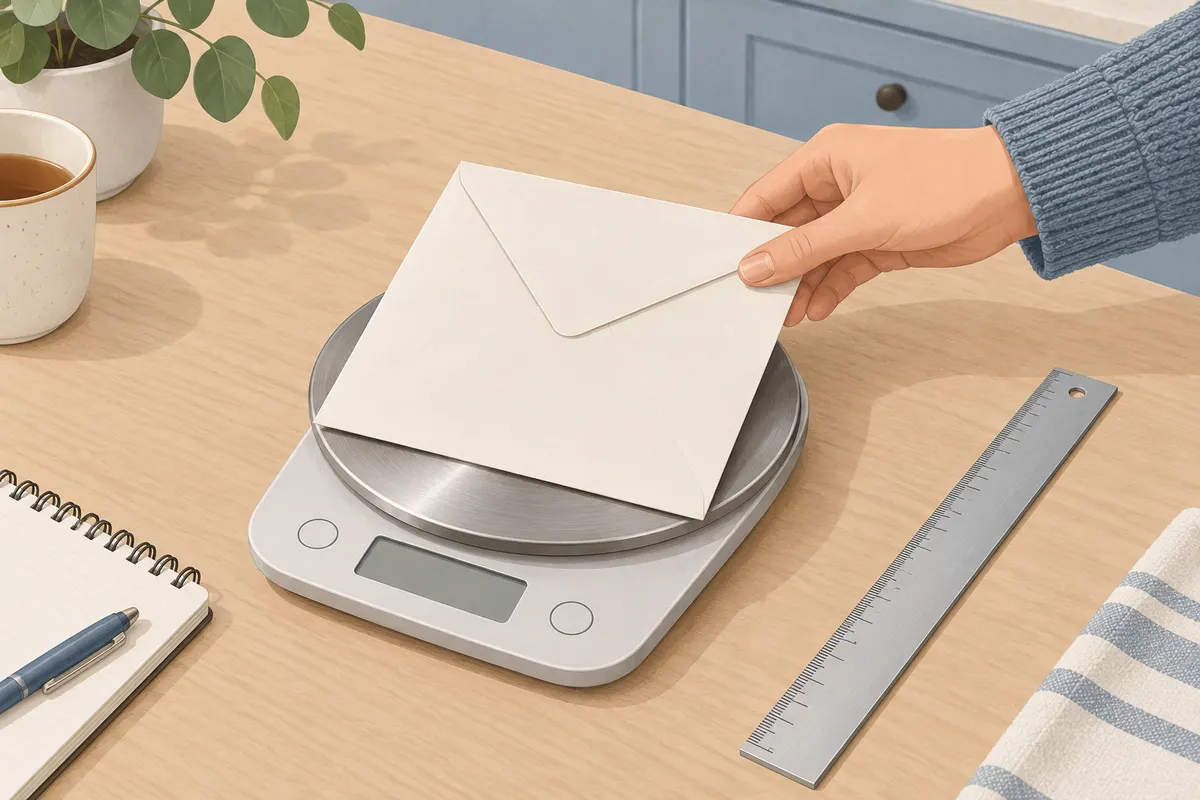
Worked example: a 15 cm square card
Suppose a hypothetical sealed envelope measures 15 × 15 × 0.4 cm and weighs 35 g. It is square, so it is not standard-size mail. It fits the non-standard within-specified-size maximums, and the weight falls in the up to 50 g band. Japan Post’s table checked on 30 October 2026 lists that band at ¥140. The standard-size 50 g rate is ¥110, so the difference in this example is ¥30. Japan Post: domestic rate table
If the same envelope grows to 55 g, it moves into the non-standard up to 100 g band, listed at ¥180 on the same table. If a thick ornament pushes it over 3 cm, the within-specified-size example no longer applies. These are rate-table calculations, not quoted prices for a product or a promise that an unusual construction will be accepted.
Could a different envelope save postage?
If the card can be placed without damage into a rectangular envelope meeting the standard-size length, width, thickness and weight limits, the standard rate may apply. A square 15 cm card will not fit flat into a standard envelope whose width is at most 12 cm, so that option would require changing the card’s format or folding it. Do not fold a certificate, photograph or artwork merely to reach a cheaper category if the recipient needs it intact.
The Japanese envelope-size guide explains common rectangular envelopes. This article answers a different question: whether the shape of the finished item alone changes the domestic category. Use the postage calculator with the measured item, and recheck the official rate table when mailing.
First-party sources checked
- Japan Post: Standard Mail Services and square-item FAQ
- Japan Post: current domestic letter conditions and prices
Related guides
Compare common Japanese envelope sizes and the domestic letter mailing steps.