No. For ordinary domestic Yu-Packet at the basic rate, reducing a package from 2cm to 1cm no longer lowers the postage: the current rate is ¥360 for thickness up to 3cm. Japan Post introduced the change on October 1, 2026. Thin packaging can still help an item fit, but the old ¥250 and ¥310 thickness bands are no longer the current basic rates. Japan Post service page, official rate-change announcement, page 2
What changed in the thickness calculation?
The announcement replaces the previous ¥250, ¥310 and ¥360 basic bands with ¥360. This guide concerns the ordinary basic service, not a marketplace’s contracted shipping product or a similarly named service.
For a hypothetical sender posting ten otherwise eligible items, changing the thickness of each from 1.8cm to 0.9cm produces no basic-postage saving: ten times ¥360 is ¥3,600 in either case. Packaging costs are excluded. Do not remove useful protection solely to reach the former 1cm price band.
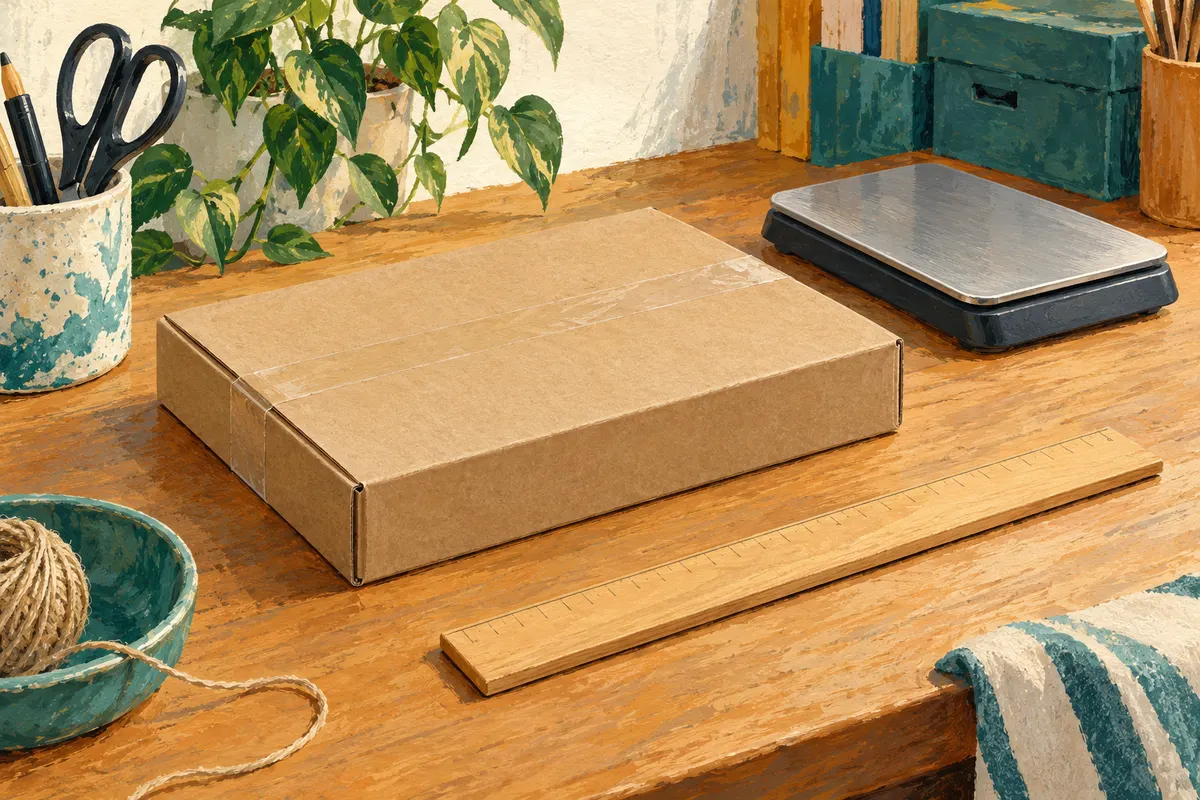
Check four limits, not thickness alone
Japan Post lists a maximum combined length, width and thickness of 60cm, a longest side of 34cm, thickness of 3cm and weight of 1kg. All apply together. Yu-Packet overview
Use the completed package in the following calculation. These are hypothetical measurements, not acceptance tests:
| Packed dimensions and weight | Combined dimensions | Result against these limits |
|---|---|---|
| 33 × 24 × 2cm; 700g | 59cm | Within all four stated maxima |
| 34 × 24 × 3cm; 700g | 61cm | Too large in total, despite meeting the longest-side and thickness limits |
| 33 × 24 × 2cm; 1.05kg | 59cm | Too heavy |
| 33 × 23 × 3.2cm; 700g | 59.2cm | Too thick |
The second row is an easy mistake: a 34cm long side does not automatically permit every width at 3cm thickness. Subtracting 34 and 3 from 60 leaves 23cm for the remaining side. That is a calculation of one limit, not a recommendation to pack exactly at every boundary.
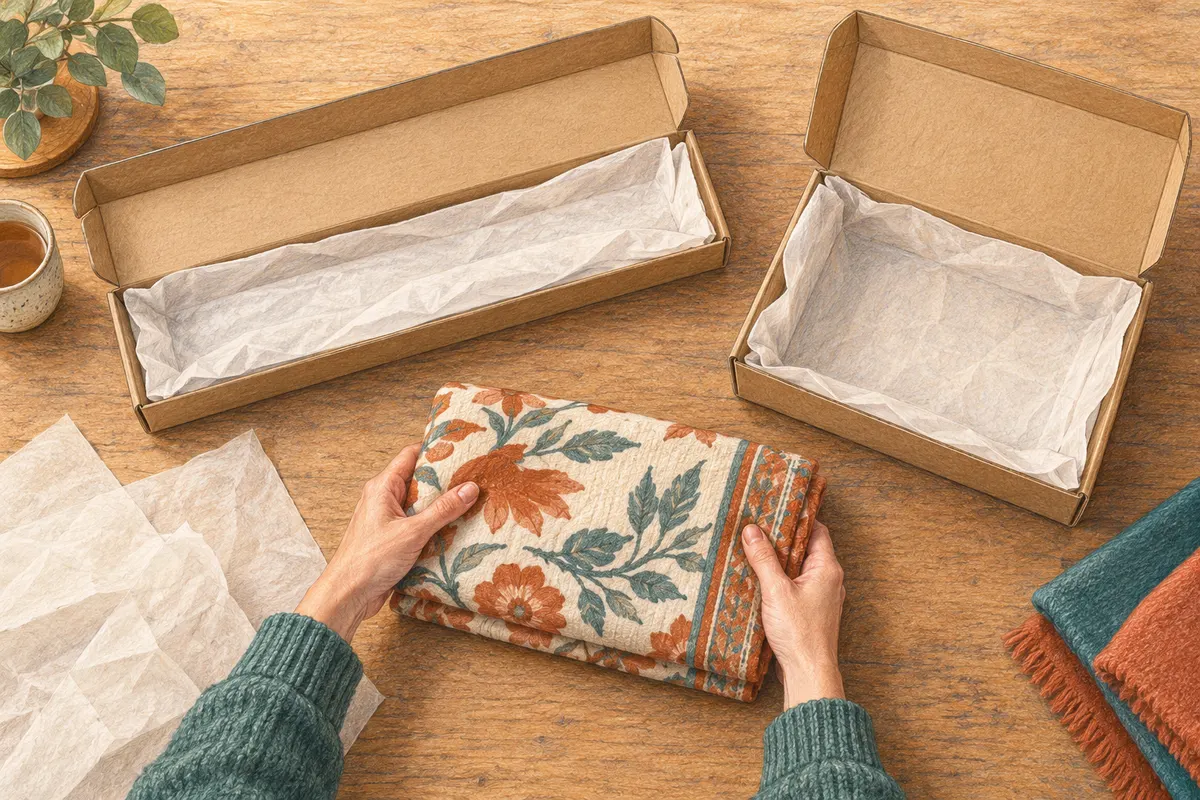
Decide whether repacking solves the actual problem
First record which condition fails. If only the combined dimensions fail, a differently shaped package might help. If the item itself exceeds the weight limit, changing the shape will not solve that problem.
For example, in the 61cm case, reducing width from 24cm to 23cm would bring the sum to 60cm mathematically. Whether the goods can be protected in that package is a separate physical question. The calculation does not justify crushing the contents or measuring a temporarily compressed parcel.
If a finished item is close to a boundary or bulges unevenly, take it to the counter for assessment before relying on a price. Do not treat a ruler calculation as confirmation that the contents qualify.
What the ¥360 service does—and does not—provide
The ordinary service uses a dedicated address label available from post offices, can be handed in at a counter or posted in a suitable post box, and provides tracking. Japan Post states that it does not compensate for damage or loss. It cannot carry correspondence, apart from the stated exception for unsealed accompanying letters or shipping documents. Procedure and conditions
This matters when the contents are important paperwork rather than small goods: matching the dimensions is not enough to select a service. Likewise, do not use tracking as a substitute for deciding how much loss you could tolerate.
This is desk research checked on October 27, 2026, with original arithmetic examples. No parcel was posted or physically measured. Recheck the exact service name and current official terms when mailing; a saved old table can give a plausible but obsolete price.
Sources checked
Source check date: 2026-10-27