Seeds and seedlings may qualify for Japan’s domestic fourth-class plant-seed mail category, but “it is a plant” is not a sufficient test. Japan Post describes this category as seeds, seedlings, young trees, and stems or roots for planting, and requires fourth-class items to be sent open for inspection, with a separate exception for certain silkworm eggs. This guide concerns plant material, not that exception. Japan Post: third- and fourth-class mail
The Japanese term to look for is 植物種子等郵便物. Confirm the contents and route before looking for the lowest weight band.
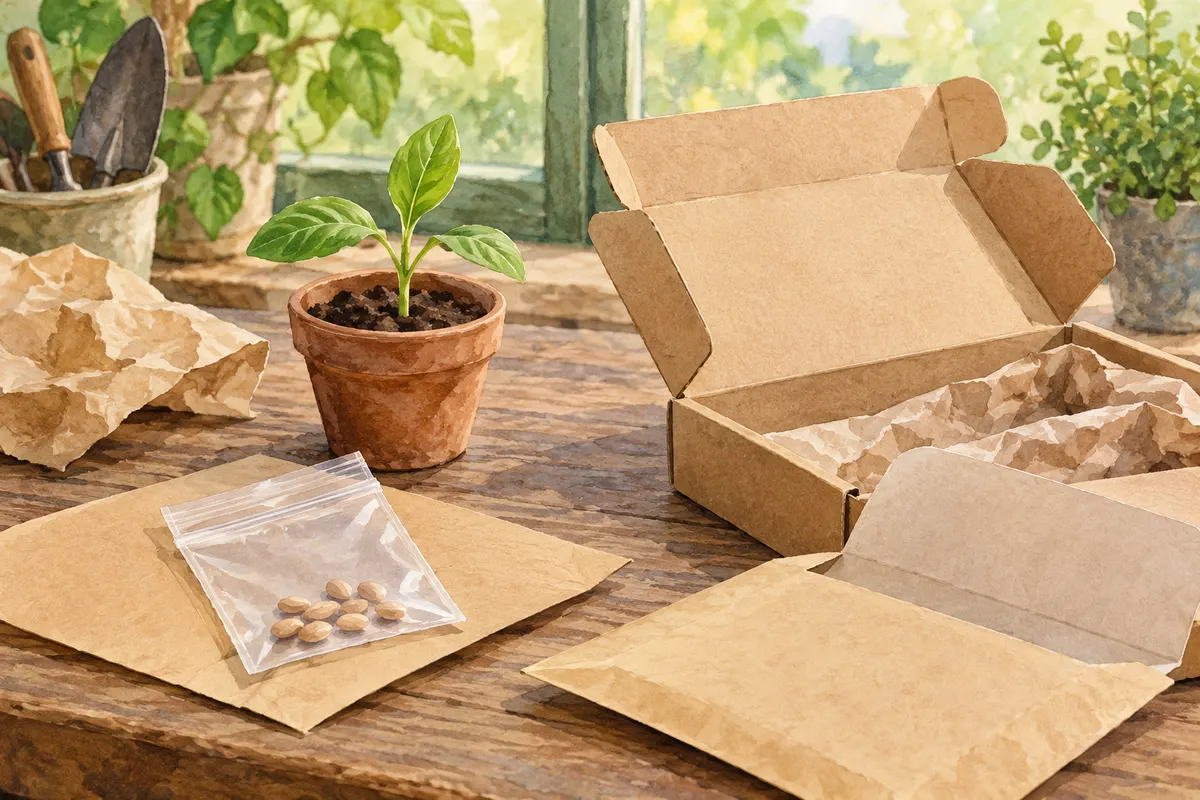
Explain what is inside and what it is for
For a hypothetical envelope of seeds intended for sowing, the planting purpose fits the description to investigate. A seed-based snack should not be assumed to qualify merely because its ingredients are seeds. A gift box containing a plant plus unrelated accessories should not be treated as automatically eligible in full.
These are decision examples, not individual acceptance rulings. Tell the counter what the actual contents are, including any additional items. If the contents are ambiguous, ask about the category before finalizing the packaging. The official description is narrower than a general discount for gardening purchases.
For an English-speaking sender, a practical question is: “These are seeds for planting. Can I send them as 植物種子等郵便物?” Follow with the actual species and whether the package contains anything else. Do not substitute a generic “gift” description for its contents.
Keep the inspection requirement separate from packing protection
Japan Post’s published requirement is open mail. An ordinary, completely sealed parcel is therefore not a preparation method to assume will satisfy this category. Arrange for the contents to be checkable while keeping them protected against spilling or damage, and confirm your proposed packaging at the counter before handing it over. Fourth-class category conditions
This guide does not prescribe a universal window size, plant-wrapping technique or soil treatment. The appropriate packaging depends on the material, and a postal category does not establish that a living plant will survive the journey.

Weigh the finished item, then select the band
The plant-seed category has a 1kg limit. The official size page also gives minimum and maximum dimensions; check the finished package against those diagrams as well as its weight. The 3kg exceptions listed there are for other specified fourth-class categories, not a general allowance for seedlings. Japan Post: size and weight
The reviewed rate table lists these selected base-postage bands:
| Finished weight | Base postage |
|---|---|
| Up to 50g | ¥73 |
| Over 50g, up to 75g | ¥110 |
| Over 75g, up to 100g | ¥130 |
| Over 300g, up to 400g | ¥290 |
| Over 400g, up to 1kg | Add ¥52 for each additional 100g or fraction |
Source: Japan Post domestic rates, plant-seed mail section. These are selected bands, not the complete rate table.
Consider two hypothetical packed items. At 450g, the amount above 400g is 50g, which occupies one additional band: ¥290 + ¥52 = ¥342. At 501g, the excess is 101g, which occupies two: ¥290 + 2 × ¥52 = ¥394.
The second calculation is why you should not round 501g down to 500g. It is also why weighing seeds alone is insufficient: the packet, protective material and address materials belong in the finished weight. These examples calculate base postage only, not optional services.
Domestic post does not remove plant-movement restrictions
Japan’s Plant Protection Station explains that some plants and pests are subject to domestic movement restrictions, including movements from affected southwestern islands and the Ogasawara Islands. Depending on the plant and route, movement can be prohibited or require inspection or treatment. Plant Protection Station: domestic movement rules
Check the species, plant part, origin and destination before sending. If any is uncertain, resolve that question with the Plant Protection Station rather than assuming that postal-size eligibility grants permission. This guide does not provide species-specific clearance.
Once eligibility and movement conditions are settled, confirm inspectable packaging, finished dimensions and weight, then obtain the correct postage. For overseas shipments, start a separate international-post and plant-quarantine check; this domestic category is not an international shipping permission.
This is desk research checked on October 29, 2026. No live plant was packed or sent, and no shipment-specific inspection or delivery-survival test was performed.