If you discover damage inside a delivered Yu-Pack, keep the contents and outer packaging and contact the post office that handled delivery promptly. Japan Post’s FAQ asks customers to report parcel damage within 14 days of receiving it. However, that same FAQ states an exception for parcels charged the security-service fee: it does not offer compensation after receipt under that provision. Identify the service before assuming the ordinary reporting window applies. Japan Post: damage discovered after receipt
This guide covers the initial response to damage in a domestic Yu-Pack. It is official desk research, not a claim filed by the author or a decision that a particular loss qualifies for payment.
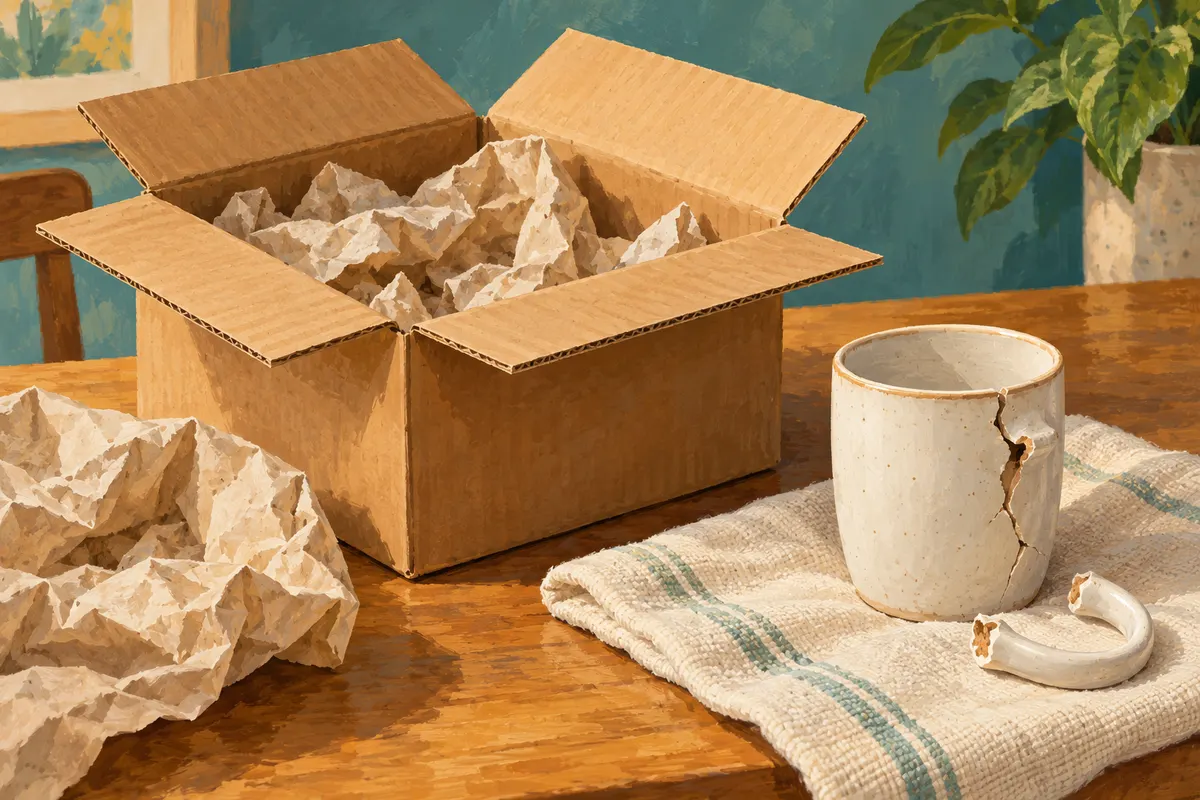
Keep the box, not just the broken item
Japan Post specifically asks customers seeking compensation for damaged Yu-Pack or registered items to retain the outer wrapping or box as well as the contents. It directs them to the delivery post office to request the procedure. Japan Post: dirty, wet or damaged mail
As an additional preparation step, keep the address label and packing materials with the parcel, and make a short record of what you found. Photographs may help you explain the condition, but this guide does not establish that photographs replace the physical packaging or any documents Japan Post requests.
Avoid discarding the box simply because it looks less damaged than the contents. Also ask the office how it wants the item handled before returning it to the seller or arranging a repair. The purpose is to keep the situation available for examination, not to promise that preservation alone proves when or how damage occurred.
Use the delivery date, not the day you opened it
The FAQ’s ordinary-parcel wording starts from receipt of the parcel. It does not give a new 14-day period each time someone opens a box later. Japan Post’s reporting window
Consider a hypothetical parcel left unopened for ten days after receipt. When damage is found, the useful action is to contact the delivery office immediately with both dates. Do not treat the discovery date as a reset, and do not postpone contact until every receipt or photograph has been assembled.
Record the actual dates rather than calculating the last possible hour yourself. This guide does not resolve calendar-counting disputes, deadline extensions or exceptions for an individual claim. If a deadline may already have passed, explain that accurately and ask the office about your case; do not alter the reported receipt date.
Check whether it was sent with security service
The service name matters. The damage-after-receipt FAQ explicitly distinguishes parcels for which the security-service fee applies. Its ordinary 14-day wording therefore cannot be presented as a universal rule for every Yu-Pack shipment. Japan Post: the security-service exception
If you are uncertain, give the office the tracking number and ask which service was used. A sender’s statement that an item was “insured” is less precise than identifying the actual postal service and fee. Do not assume that a higher compensation ceiling automatically means a longer post-delivery reporting period.

Prepare one clear account for the delivery office
Use a factual note like this. It is an editorial template, not an official claim form:
| Item to record | What to write |
|---|---|
| Parcel identification | Tracking number and service, if known |
| Receipt | Actual date received |
| Discovery | When you opened it or noticed the damage |
| Condition | What is broken, wet or otherwise affected; separate observations from guesses |
| Retained material | Contents, box, label and packing material available |
| Next question | What should be preserved or submitted, and what procedure applies? |
An example phrase for the initial enquiry is: 「受け取ったゆうパックの中身が壊れていました。箱と内容品は保管しています。手続を教えてください。」 This means, “The contents of a Yu-Pack I received were damaged. I have kept the box and contents. Please tell me the procedure.” It is a suggested phrase, not a quotation from a postal employee.
Prompt reporting and complete records help the office assess the situation. They do not establish liability, the amount payable or an automatic refund of the purchase price. Those decisions remain part of the actual procedure.
Related guides
Security service and declared value · Packing before the counter